Saramonic SmartMic MTV500 Reviews: See Why 0 Shoppers Rated It 0 Stars!
Curious about the Saramonic SmartMic MTV500 microphone? Before you commit, see what 0 musicians thought about these Saramonic microphones — from real-world use to surprise letdowns.
 Supermod
  Moderator
 Recaptor
 Saramonic SmartMic MTV500 Review: A Versatile USB Studio Microphone for Creators
In the crowded world of USB microphones, the Saramonic SmartMic MTV500 stands out as a notable contender designed primarily for content creators, podcasters, and musicians seeking a reliable desktop USB setup. Launched in 2022, this microphone promises a combination of studio-grade audio capabilities with user-friendly features crafted specifically for intermediate and beginner levels.
What makes this microphone intriguing is its dual polar pattern type of cardioid and omnidirectional modes, equipping users with versatile recording options suitable for streaming, voice recording, and instrument capture. On paper, the SmartMic MTV500 offers a well-balanced set of features that position it well within its price range and intended professional audience.
Detailed Specs & Features
Based on its engineering data, the SmartMic MTV500 features a large diaphragm capsule with a 0.4-inch diameter, designed to capture rich, full-bodied sound. Its USB microphone type ensures straightforward plug-and-play compatibility with both PC and Mac platforms, supported by USB-A and USB-C interfaces, making it future-ready for various setups.
The frequency response spans from 20 Hz to 20,000 Hz, covering the full audible spectrum, which means on paper it is capable of capturing everything from deep bass to crisp highs. This range is complemented by a respectable signal-to-noise ratio of 80 dB, indicating that the microphone should perform well in producing clear audio with minimized background hiss. The maximum sound pressure level (SPL) of 130 dB implies the MTV500 can handle loud sources without distortion, a handy feature for recording instruments or energetic voices.
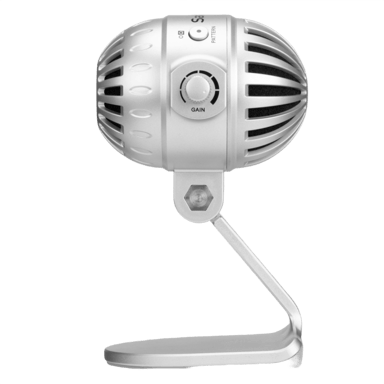
This device's onboard gain control allows users to adjust input sensitivity directly from the microphone, paired with a mute function and headphone monitoring capability that enables real-time audio checks; vital for studio or streaming environments requiring instant feedback. Physically, the SmartMic MTV500 is compact and lightweight, weighing just 44 grams, with a desktop form factor that fits neatly on any setup, stabilized by an included stand-tripod and an adjustable swivel mechanism.
User Experience & Performance (Based on Specs)
Design & Build
The SmartMic MTV500 uses a plastic body with a matte finish, which helps minimize fingerprints and surface reflections. It features an internal shock mount and rubbers for internal dampening, which, according to specs, should reduce unwanted mechanical vibrations effectively during recording.
On the practical side, its integrated pop filter and windscreen are important in controlling plosives and breath noise, meaning users don't necessarily have to purchase additional accessories for clean vocal recordings.
The microphone supports a 1/4" mounting thread size, so it's compatible with many industry-standard desktop or boom stands. Despite its modest size, about 2.8 inches deep, the device feels robust enough for desktop use. Still, it probably wouldn't suit mobile field recording setups due to the lack of battery power and dependence on USB bus power.
Performance
Recording quality, driven by the large diaphragm and pressure gradient acoustic principle, should appeal to streamers, podcasters, and musicians whose priority is natural, accurate sound capture. The microphone's polar pattern switching precision is stepped, which means switching between cardioid and omnidirectional modes is stable and prevents accidental misadjustments.
While it lacks advanced DSP processing, AI noise cancellation, or multi-pattern blending, the fast transient response lends it the capability to track rapid sound attacks clearly, which is important for percussion or dynamic vocal styles. The absence of voice isolation or proximity effect control means users might need to be mindful of room acoustics or microphone placement to avoid unwanted background noise or bass boost.
Display / Audio Quality
Though there's no visual display on the microphone itself, the inclusion of headphone monitoring is a significant bonus, allowing users to listen directly to the input without latency issues. The manufacturer specifies low-latency tracking, which is a critical feature for anyone who needs to sync voice or instruments exactly in real time during streaming or recording sessions.
Audio output is unbalanced and analog through the headphone jack, tailored for typical desktop listening environments. This setup would not suit high-end studio environments demanding balanced XLR outputs, but it suits the typical podcast or streaming studio.
Extra Features
Although it lacks modern extras such as app integrations, firmware upgrades, or voice effects that are common in some competitors, the inclusion of practical basic controls, such as mute, gain, and monitoring, makes it straightforward and effective.
The microphone does not rely on phantom power. It is powered entirely via USB bus, simplifying connectivity but limiting flexibility if users want to use it with other audio interfaces or mixers. It also provides shielding against RF interference, promising stable sound quality even in environments filled with wireless signals.
Pros & Cons
Pros
- Versatile dual polar pattern modes (cardioid and omnidirectional) for diverse recording scenarios
- Fast transient response combined with a large diaphragm for clear, natural sound capture
- Integrated headphone monitoring with low latency enhances real-time tracking accuracy.y
- Compact, lightweight desktop design with an adjustable swivel stand for easy positioning
- Includes a shock mount, pop filter, and windscreen for controlled recording conditions
Cons
- Lacks advanced DSP or AI noise cancellation features found in competing models
- No phantom power support or XLR output limits professional studio integration.
- No onboard touch or LED indicators, which might slow down quick setting confirmations
- Power source limited to USB bus power, preventing portable or battery-backed recording.
Price & Value for Money
Priced at $125 at SaramonicUSA.com, the SmartMic MTV500 offers a two-year warranty and a solid warranty period backing its build quality and technical reliability. Given its comprehensive studio-oriented features, especially the multi-polar pattern switching and integrated monitoring, the pricing feels justified for home studios and entry-level professional setups.
While it won't replace high-end broadcast microphones with XLR outputs or DSP capabilities, it represents a budget-friendly solution with clear audio performance and ergonomic ease. If you value direct USB connectivity paired with practical control features, this microphone is a noteworthy candidate.
Quick Take
In short, the Saramonic SmartMic MTV500 balances affordability and functional design to serve content creators needing flexible directional recording with clean and natural sound. If we look at the numbers alone, it's a combination of fast transient response, reliable gain control, and convenient headphone output that makes it a smart pick for podcasting and streaming beginners alike.
Closing Recommendation
Though it may be ideal for entry-level and intermediate users prioritizing ease of use and versatility, the SmartMic MTV500 appears to perform best for desktop-based recording rather than mobile applications due to its USB power dependency. It helps users achieve high-quality audio without the complexity of external preamps or phantom power, striking a balance between professional intent and accessibility. For those seeking advanced signal processing or multi-device pairing, other options might suit better, but for straightforward, dependable USB recording, this microphone earns its place.
Verdict
Rating: Based on the specifications and overall feature set, we believe Saramonic SmartMic MTV500 deserves 4.1 out of 5.
- Winner Feature => flexible dual polar patterns and integrated headphone monitoring for versatile, real-time tracking.
- Needs Improvement => absence of advanced DSP features and lack of professional XLR output limit studio-level integration.
Reviews 0
The good, the bad, and the brutally honest.Average Rating


More Microphones 1229
Unlock more awesome finds.